
墨 · 色——当代纸本艺术作品邀请展
墨 · 色
——当代纸本艺术作品邀请展
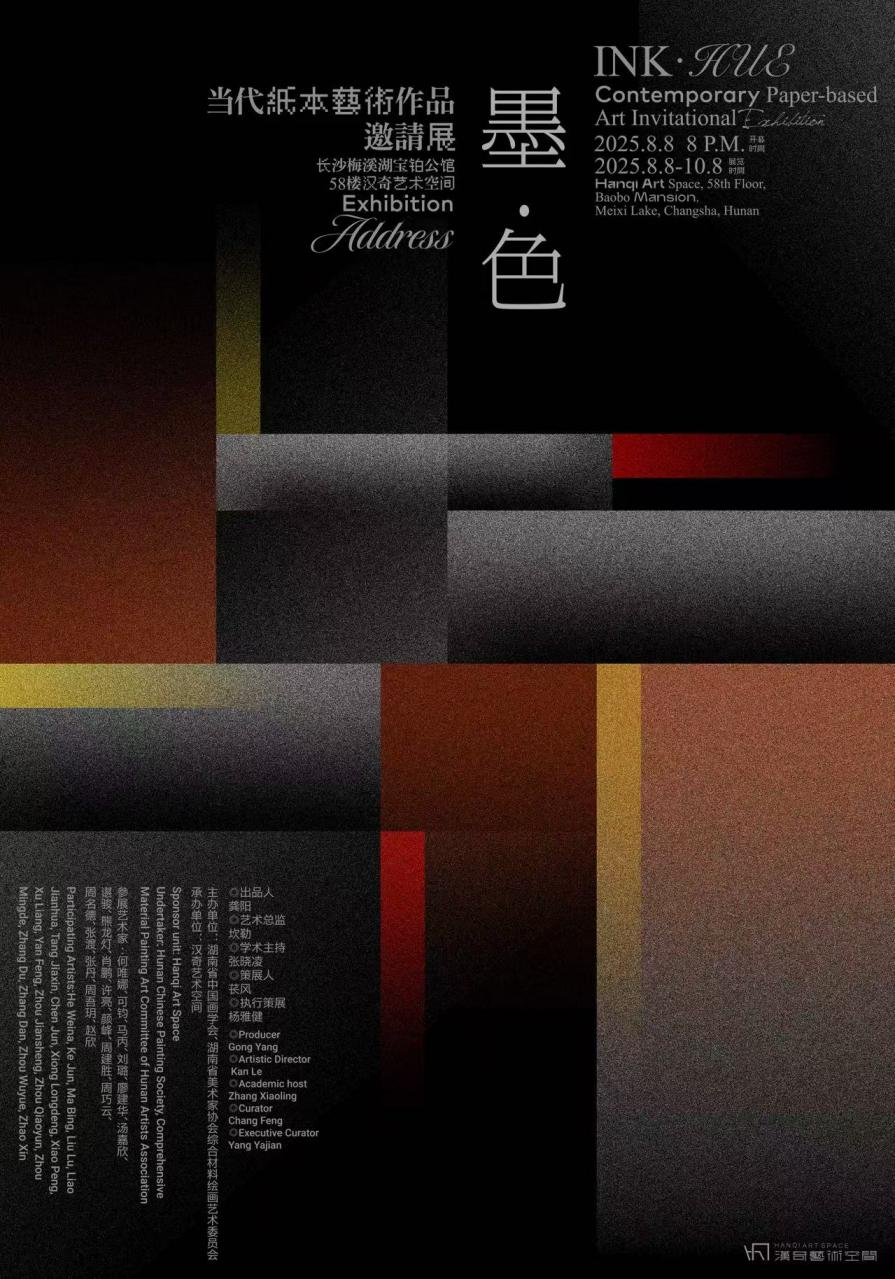
Ink·Hue – Contemporary Paper-based Artwork Invitational Exhibition
出品人 /龚阳
Producer: Gong Yang
艺术总监 /坎勒
Art Director / Kan Le
学术主持 /张晓凌
Academic Host /Zhang Xiaoling
策展人 / 苌风
Curator / Chang Feng
执行策展 /杨雅健
Curatorial Director / Yang Yajian
艺术家Artists:
何唯娜、可钧、马丙、刘璐、廖建华、汤嘉欣、谌骏、熊龙灯、肖鹏、许亮、颜峰、周建胜、周巧云、周名德、张渡、张丹、周吾玥、赵欣
He Weina, Ke Jun, Ma Bing, Liu Lu, Liao Jianhua, Tang Jiaxin, Shen Jun, Xiong Longdeng, Xiao Peng, Xu Liang, Yan Feng, Zhou Jiansheng, Zhou Qiaoyun, Zhou Mingde, Zhang Du, Zhang Dan, Zhou Wuyue, Zhao Xin
开幕 Opening
2025.08.08 8:00 PM
展期 Duration
2025.08.08 – 10.08
主办:湖南省中国画学会、湖南省美术家协会综合材料绘画艺术委员会
Organizers: Hunan Chinese Painting Society, Hunan Artists Association Comprehensive Material Painting Art Committee
承办:汉奇艺术空间
Undertaker: Hanqi Art Space
地址:湖南省长沙市梅溪湖宝铂公馆58楼汉奇艺术空间
Address: Hanqi Art Space, 58th Floor,Baobo Mansion, Meixi Lake, Changsha, Hunan
「前言Preface」
中国水墨画的发展得益于纸的发明与创造,以“墨色书写”成为水墨画的代表形式,并延续至今。纸张的最大优点在以墨色书写,墨水渗入纸中,难以擦拭掉,因此早期纸张代替了木简和绢帛,成为主要的书写工具。由于其“白底黑字”的特性,便于书写,难以伪造文件,成为世界各国保存文献、记载历史、交流思想以及打破时间、空间的限制方面发挥重大作用。中国画家最早就借助宣纸的生熟纸质,进行勾勒填色和泼墨渲彩。尤其是明清两朝以来所制的生宣纸,因其强吸水性和沁水性,最容易产生丰富的“晕化”变化。
“墨分五色”,“墨色同辉”,借助毛笔的柔中带刚的特性,使得笔触层次分明,干湿浓淡,变幻多端。随着纸张的不断更新,中国水墨画早已超越单纯的创作载体,不仅成为现代中国画定义为“水墨”的一个重要元素。也是“85”新潮以来,水墨画进入了深刻的现代性探索阶段。然而,作为一种创作形式的宣纸笔墨,其本身早已挣脱了以往的笔情墨趣,而成为艺术家观念的自由舒展。“墨”与“色”之间,始终是艺术家难以割舍的话题。
纸,经过千年的演化,涌现出各种各样的纸张。纸的发展史,实际上是世界文字和艺术演变的历史。尽管纸只是一种载体或工具,但它和文化艺术息息相关。早期的纸张推动了文化艺术的传播与演变,而随着文化艺术进一步发展,纸张也不断进行改革和创新。然而在AI数字化、智能化的当下,作为材质、媒介和手工艺的纸日渐从人们的生活中退出,但纸经过千年演变,包含着深厚的历史渊源和精神内涵,纸艺术在不断实践中也体现出自身独特的文化特征和当代价值。
本次展览以“墨·色”为主题,呈现各种纸本的创新过程,邀请了18位艺术家参展,其一;探究当代水墨的观念介入,其二;是各种纸张的不同运用下,探索当代艺术的多元性和独创性。参展艺术家对纸和墨,都情有独钟,在不同的纸上展开实践,或墨色浑厚华滋,或色彩浓艳流动;或以泼墨大写非黑即白,或以笔笔精妙点点到位。无论是对传统水墨的分析与解构;打破时空界限的空间重构,或根植于传统的蓝本而表现当下的观念,还是构建于自己的黑白空间体系。艺术家的这些实践本身都是对纸与墨这种媒介的观念探索。文/苌风
The development of Chinese ink painting owes much to the invention and evolution of paper. The practice of “ink writing” became its defining form, a tradition that continues to this day. Paper’s greatest virtue lies in its capacity for ink-based writing—once absorbed, the ink becomes indelible, allowing paper to replace bamboo slips and silk as the primary medium for writing during ancient times. Its characteristic “black characters on white background” not only facilitated writing but also made forgery difficult, enabling paper to play a pivotal role globally in preserving documents, recording history, exchanging ideas, and transcending temporal and spatial boundaries. From the earliest periods, Chinese painters leveraged the unique properties of both raw and processed Xuan paper for techniques like outlined coloring and ink-splashed washes. Particularly since the Ming and Qing dynasties, raw Xuan paper—with its exceptional absorbency and water-permeability—has been prized for producing rich, nuanced “ink diffusion” effects. “Ink manifests in five hues” and “ink and hue shine in harmony” — through the brush’s unique quality of resilience within softness, strokes achieve layered depth, with variations in dryness, wetness, intensity, and subtlety. As paper evolved continuously, Chinese ink painting transcended its role as a mere creative medium. It has not only become a defining element of modern Chinese painting—what we now term “ink art”—but also, since the ‘85 New Wave movement, entered a profound phase of modernist exploration. Yet as a creative form rooted in Xuan paper and ink, it has long broken free from traditional brushwork charm to become an unfettered expression of artistic concepts. The dialogue between “ink” and “hue” remains an enduring, inseparable pursuit for artists.
Paper, through millennia of evolution, has given rise to an extraordinary variety of forms. The history of paper is, in essence, a history of the written word and artistic expression across civilizations. Though merely a medium or tool, paper has been inextricably intertwined with culture and art. Early paper facilitated the dissemination and transformation of cultural and artistic practices, while subsequent advancements in these fields, in turn, drove continuous innovation in papermaking itself. Yet in today’s AI-driven, digital age, paper as a material, medium, and handcrafted artifact is gradually receding from daily life. Nevertheless, its millennia-long evolution has imbued it with profound historical resonance and spiritual depth. Through ongoing artistic experimentation, paper art continues to manifest its unique cultural identity and contemporary significance.
This exhibition, under the theme “Ink·Hue”, presents innovative explorations in paper-based art, featuring 18 invited artists. Their works engage in two primary investigations: On one level, the exhibition examines conceptual interventions in contemporary ink art; on another,it explores the diversity and originality of contemporary art through diverse applications of paper. The participating artists share a deep affinity for paper and ink, each experimenting across different surfaces—some achieving richly layered ink expressions, others employing vivid, flowing colors; some embracing bold, monochromatic splashes, while others demonstrate meticulous, dot-by-dot precision. Whether through the analysis and deconstruction of traditional ink art, the spatial reconfiguration that transcends temporal boundaries, the reinterpretation of classical paradigms to express contemporary concepts, or the construction of personal monochromatic visual systems—these artistic practices collectively embody a conceptual exploration of paper and ink as mediums.By Chang Feng